A casino manager opens the morning dashboard and sees that revenue has fallen. The next question is straightforward: what changed, and where should the team look first?
A player opens the same operator’s website and cannot understand why a bonus balance differs from the amount available to withdraw. Their question is just as reasonable: what do these numbers mean for my account?
Both situations can benefit from an AI assistant. They require different information, different permissions and a different definition of a useful answer.
AI agents in iGaming now span work inside the operator and experiences delivered directly to players. Understanding that distinction makes it easier to choose a sensible starting point, connect the right systems and judge whether the result actually helps. It also explains why an assistant built for an analyst should not simply become a chat window in the casino lobby.
Two audiences, two kinds of context
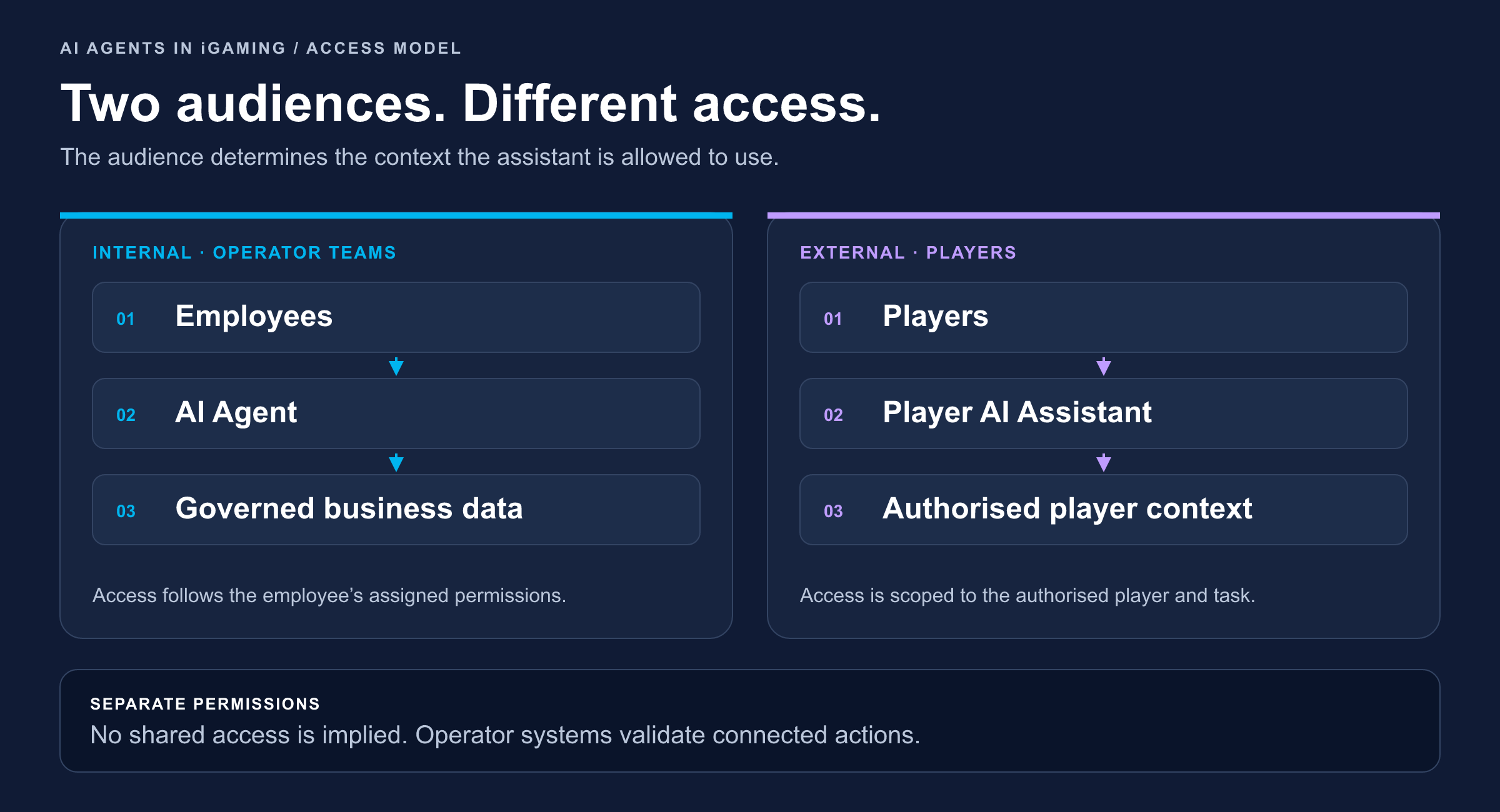
For employees, an AI agent can help investigate business performance. It works with the operator’s connected data, shared metric definitions and the access available to the person asking. An acquisition manager might explore a conversion change; finance might examine revenue deductions.
For players, the purpose is personal assistance within the operator’s service. Relevant context includes approved rules, available events or games, and the authenticated player’s own account information where connected and authorised. That scope should exclude employee analytics, other players’ records and internal commercial assessments.
Gamblitude addresses these audiences through its internal AI capabilities and a separate Player AI Assistant, which brings text and voice conversations into sportsbook, online casino and sweepstakes experiences.
| Question | AI for operator teams | Player AI Assistant |
|---|---|---|
| Who uses it? | Employees working within their assigned access | Players using the operator’s website |
| What does it help with? | Analysis, recurring investigations and reports | Discovery, explanations, account help and support journeys |
| Which context is relevant? | Governed Metrics, Attributes and connected business data | Approved knowledge and the player’s authorised personal context |
| What determines access? | Employee roles and dataset permissions | Authentication, account scope and permitted player journeys |
| Who controls the next step? | The responsible team reviews findings and decisions | The player chooses; operator systems validate applicable actions |
How AI agents support an operator’s working day
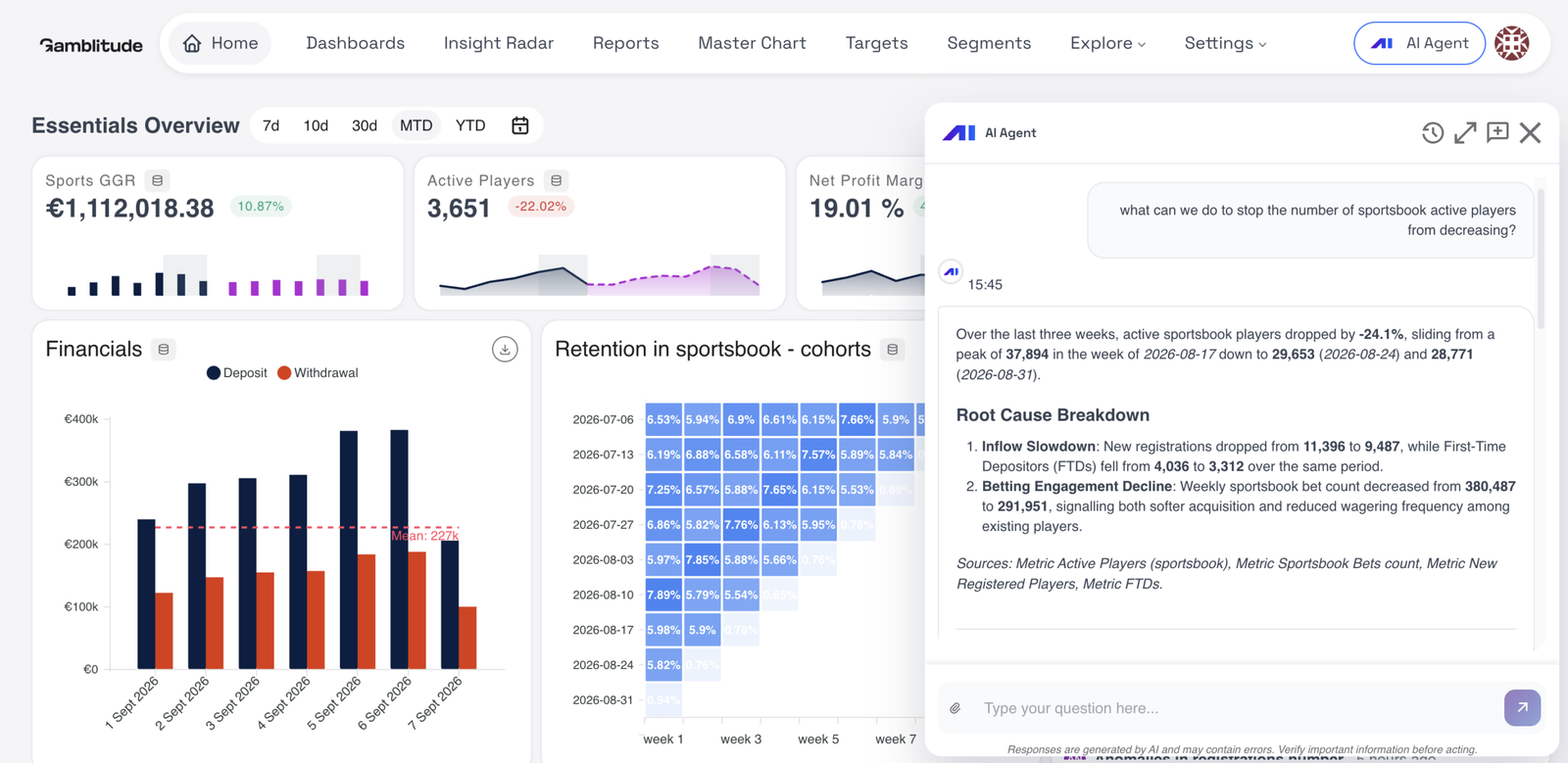
An internal agent becomes useful when someone can ask a business question and examine the answer. “Why did revenue fall?” needs a defined revenue measure, a period, a comparison and relevant breakdowns. A confident paragraph without those foundations leaves the original analytical work unfinished.
In Gamblitude’s AI for iGaming, several ways of working share the same analytical foundation:
- AI Agent: an employee starts a conversation, examines the supporting figures and asks follow-up questions.
- Insight Radar: the team defines an investigation and schedule for a question worth checking repeatedly.
- Reports: a brief becomes a document with charts, analysis and commentary that the team can review and edit.
- Autonomous Agent: investigations begin without a new question or a predefined recurring check.
These distinctions describe how the work starts. A scheduled conversion review and an independently discovered pattern can both lead to a conversation, a saved chart or a team review.
The Autonomous Agent selects investigative threads and brings findings to the team. Autonomy here concerns investigation. The finding does not itself authorise a campaign change, a new bonus or a change to a player’s account. The responsible team decides how to respond.
An example: first deposits fall faster than registrations
Consider an illustrative acquisition review. One source generated 100 registrations and 40 first-time depositors in the earlier period. In the later period, it generated 80 registrations and 20 first-time depositors. Registrations fell by 20%, while first-time depositors fell by 50%. Registration-to-first-deposit conversion moved from 40% to 25%.
That gives the team two changes to investigate. Lower traffic alone does not account for the full result. An analyst can examine conversion by device, market or registration cohort, using comparable windows and the available data. A payment or verification issue is a hypothesis to check, not a cause established by the headline numbers.
The useful output is a clearer investigation: the definitions used, the relevant breakdown and what remains uncertain. The team might then ask product colleagues to review a specific step in the journey. If a fix follows, its result needs separate measurement. Producing the initial explanation is only one part of the work.
Bringing personal assistance to players
Players encounter a different set of problems. They may understand what they want but struggle with the navigation, terminology or status information needed to reach it. A conversational interface can make those steps easier to follow, particularly when the answer depends on account context.
Player AI Assistant supports chat and voice, with connected capabilities shaped around the operator’s agreed scope. Voice changes how someone interacts; it does not expand what the assistant is allowed to access or do.
The experience also needs to reflect the product:
- Sportsbook: help players find events, understand markets and prepare selections for a betslip. The operator’s systems remain responsible for current odds, eligibility, balances and transaction validation.
- Online casino: help players explore the available catalogue, understand game mechanics and clarify promotion terms using approved information.
- Sweepstakes casino: explain the operator’s separate coin balances, participation routes, eligibility requirements and prize redemption request information.
Support and request follow-up depend on the corresponding systems being connected. A conversation about a request is most useful when it can refer to an actual status and tell the player what happens next.
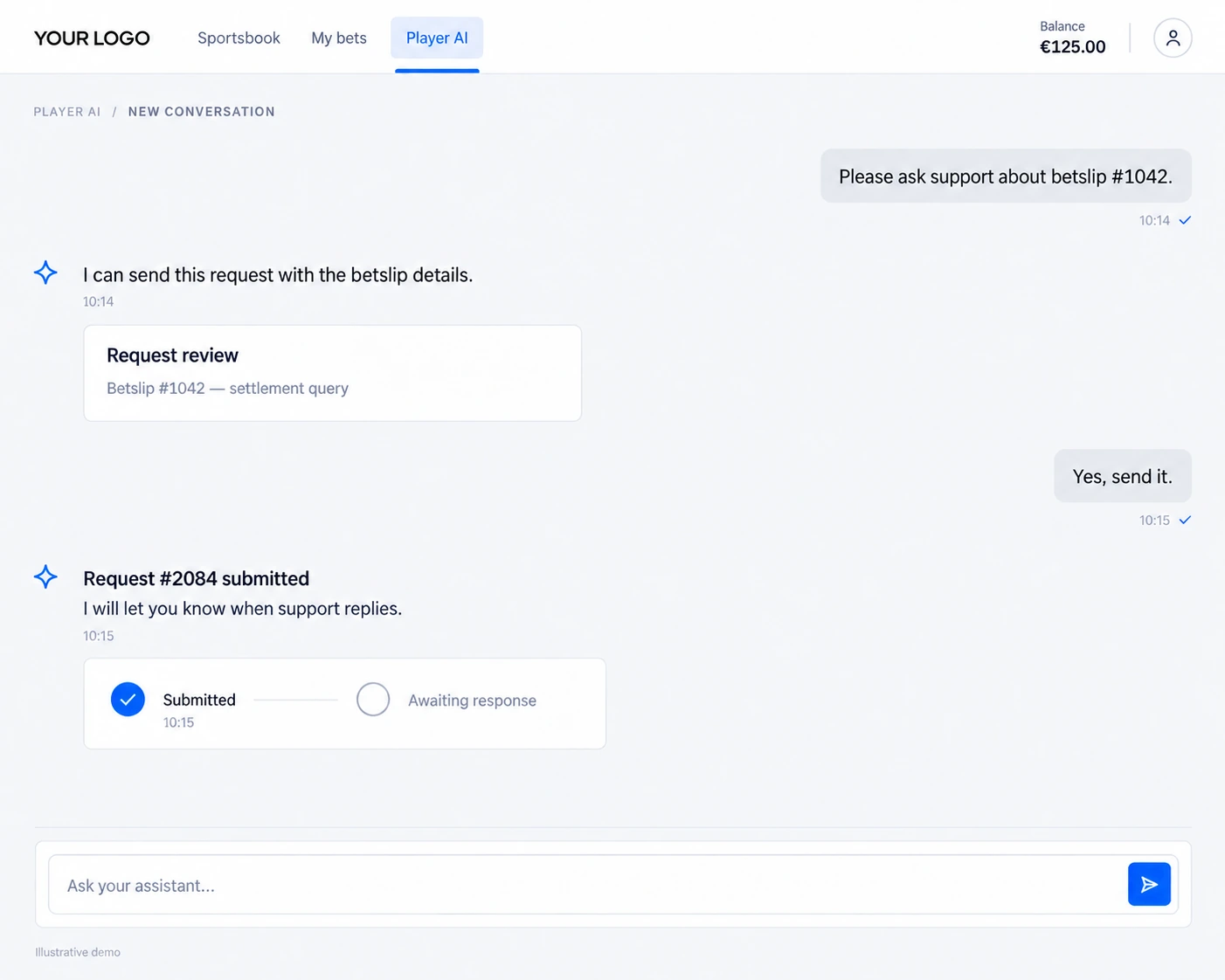
An example: explaining a bonus and following a support request
Imagine a player asking, “Why is my bonus balance different from my withdrawable balance?” In an illustrative connected journey, the assistant retrieves the relevant account information and approved promotion terms. It explains the distinction and identifies which conditions apply, without guessing that an offer is active or promising that a balance can be withdrawn.
If the player believes the balance is wrong, the next step may be an approved support workflow. With the player’s permission, the assistant can submit a request through an approved operator workflow where supported and follow its recorded status. It should report only the outcome the connected system actually confirms. An unconfirmed submission should remain visibly unconfirmed.
The goal is to resolve the question. The conversation should not turn a complaint or withdrawal concern into an invitation to keep playing. If information is missing or contradictory, a clear handover is more useful than an invented explanation.
Configure the assistant around the job
An AI assistant needs a defined role before it needs a distinctive personality. The operator should establish which questions it handles, which sources it can use and which tools it may call. Branding, tone and language then make that role feel coherent within the product.
For employee analytics, the foundation includes consistent definitions of measures such as revenue and conversion, with access scoped to the employee. The AI Agent glossary explains why business context matters to conversational analysis. An answer must also make its period and filters understandable.
For players, configuration starts with account boundaries and approved knowledge. Promotion rules need an owner and a current version. Account and request information need a reliable source. The model, instructions, available tools and conversation context should be configured for those journeys, then tested together. Instructions alone do not replace access checks in the connected systems.
Personalisation should help someone understand their own situation. It must not expose internal player-value scores or other customers’ data. Responsible gambling restrictions, communication preferences and applicable eligibility controls remain part of the operating design.
An agentic workflow needs a verified ending
An agentic workflow connects several steps towards an outcome. In iGaming, describing those steps precisely is more useful than calling the whole process autonomous.
For a player’s support question, the sequence might be: identify the request, retrieve authorised information, explain the available next step, obtain any required confirmation, use the permitted support process and check its result. For an employee investigation, the sequence might finish with evidence and a recommendation awaiting team review.
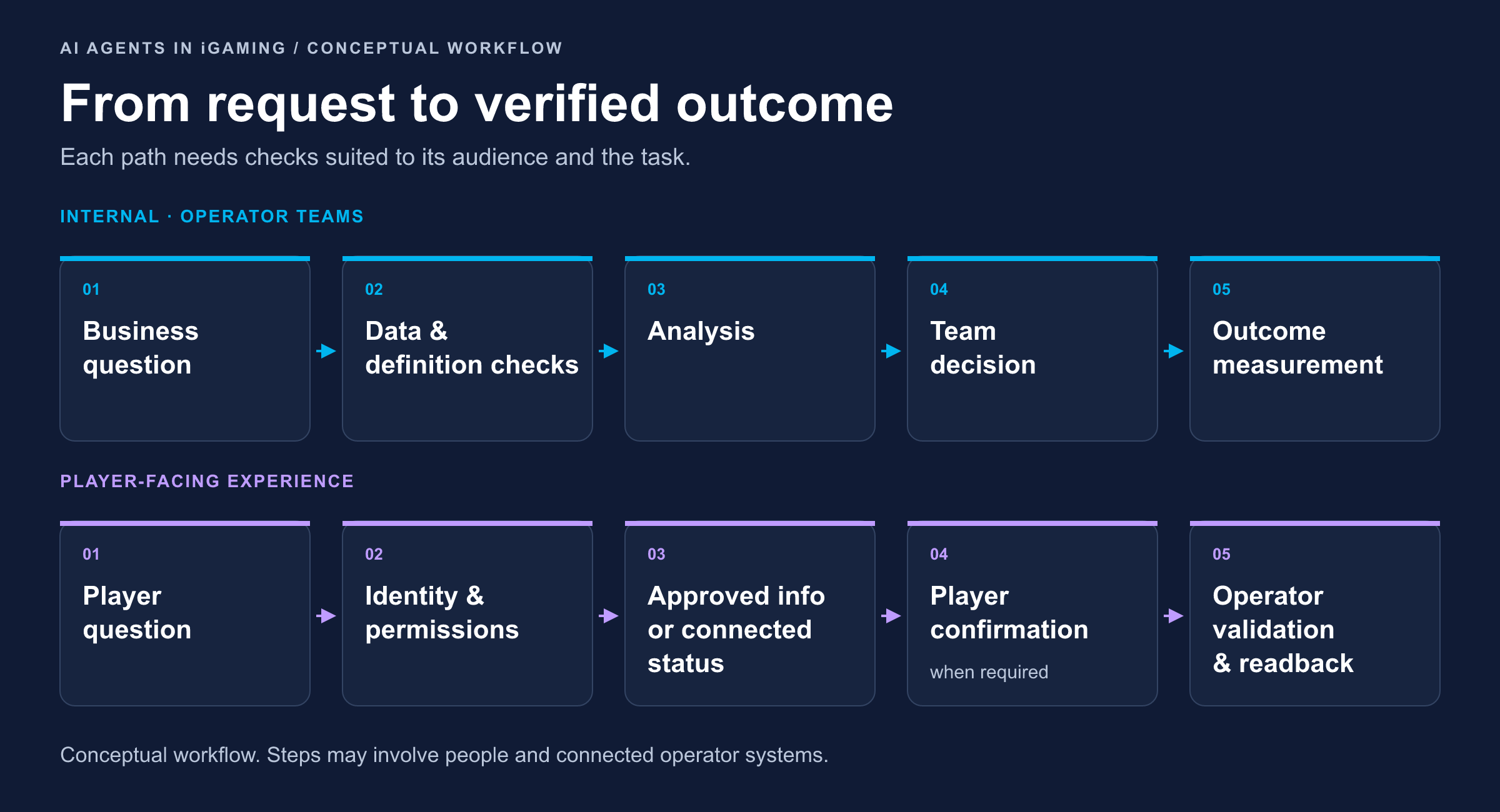
Each transition needs a clear boundary. Reading a balance is different from changing an account. Preparing a sportsbook selection is different from accepting a bet. An assistant should not play on someone’s behalf, promise a winning outcome or suggest more play to recover losses. Player decisions and required confirmations remain with the player; the operator validates any permitted transaction.
Failures need an outcome too. If a service is unavailable, the interface should explain what remains incomplete and offer the approved alternative. A message saying that something was sent does not prove that the receiving system accepted or completed it.
Start with one journey and expand on evidence
A focused pilot makes weaknesses easier to find. Choose a question that matters, has an identifiable source of truth and ends somewhere the team can verify.
For an internal pilot, that could be a recurring acquisition review using agreed definitions. For a player pilot, it could be explaining a specific promotion or following an existing support request. Trying to cover every question at launch makes it harder to know which integration or instruction needs improvement.
Work through three stages:
- Establish the sources and boundaries. Record the owner of each data source, expected freshness, access rules and permitted actions. Decide what the assistant should say when records are missing, delayed or inconsistent.
- Test representative journeys. Include straightforward questions, ambiguous wording and failures. Check account separation, expired promotions, changed request status and unavailable services. Test voice journeys as carefully as text.
- Release a limited scope and review it. Give the operational team a way to inspect errors and take over unresolved cases. Extend the scope when the existing journeys work reliably, with the next set of integrations and permissions reviewed explicitly.
The Business Intelligence Platform provides the shared environment for internal analysis. Player-facing assistance has its own integration and validation work. Success in one setting is useful experience, but it does not validate the other automatically.
Measure whether the assistance helped
For internal AI, evaluate numerical accuracy, definition and filter accuracy, the evidence behind an explanation, and the time needed to reach a usable answer. Review whether findings lead to useful investigations. Track corrections and unsupported conclusions alongside adoption.
For player assistance, examine answer accuracy, successful support completion, unresolved requests, incorrect status messages and handover quality. A conversation ending quickly is not necessarily a resolved problem. Check whether the player received an understandable answer and whether any promised next step occurred.
Separate model quality from service quality. The assistant may explain a delay correctly while the underlying support process still takes too long. Conversely, a fast response can be wrong. Review each layer before deciding what to improve.
Bet volume alone cannot establish that an assistant is useful. A good outcome can be understanding a term, finding account information or reaching human support without repeating the whole story.
Frequently asked questions
What are AI agents in iGaming?
They are systems that use context and connected tools to help complete defined tasks. For operators, that can mean business analysis or recurring investigations. For players, it can mean explanations, discovery and account assistance. The available data, tools and permissions determine their practical scope.
How is an AI agent different from a chatbot?
A chat window describes the interface. An agent may also retrieve context, use tools and follow several steps. The useful distinction is what it can reliably complete and verify, rather than the label applied to it.
Are Gamblitude AI Agent and Player AI Assistant the same product?
They serve different audiences. AI Agent supports employees investigating business data. Player AI Assistant is a separate experience for players, using approved information and their authorised account context. Employee analytics access should not carry into player conversations.
Does an autonomous agent make business decisions itself?
Gamblitude’s Autonomous Agent initiates investigations and surfaces findings. The operator’s team reviews those findings and decides how to respond. An investigative result is not automatic permission to change a campaign, award a bonus or alter an account.
Can Player AI Assistant place bets or play for someone?
For sportsbook journeys, the assistant can prepare selections for a betslip where supported. The player reviews the current odds, chooses the stake and places the bet. The sportsbook validates applicable odds, balances, eligibility and limits. The assistant does not play casino games for the player.
What should an operator connect first?
Start with the sources required for one chosen journey. Internal analysis needs agreed Metrics and relevant business data. Player assistance may need approved rules, account authentication and a specific account or support integration. Add connections when the next use case requires them.
The starting question is practical: whose work or experience should become easier, and what information is needed to help them? Explore AI for operator teams and Player AI Assistant to see how those two paths fit your operation.