Solutions · Fraud, RG, AML & Compliance
Read the pattern.
Review the evidence.
Give specialist teams the context behind a signal.
Connect available player, payment and review history for more informed assessment. Keep the sequence of events, definitions and data gaps visible while your team decides the appropriate response.
An analytical foundation for specialist work
Connected evidence.
Distinct responsibilities.
iGaming risk and compliance analytics brings behavioural, transaction and case-related data together to support specialist investigation. Gamblitude provides the shared data model, configurable Player Profiles and analytical tools. Fraud review, responsible gambling, AML assessment and regulatory reporting have different purposes and decision processes. Define the evidence each team needs, who may access it and how findings enter the operator's existing controls.
Protect the purpose of RG analysis
Evaluate behavioural indicators in the context of player protection. Agree the assessment question and review process with the RG team, independently of revenue or VIP status. Keep vulnerability and RG signals out of promotional targeting.
Reconstruct the relevant sequence
Review recorded transaction states and account history together rather than inferring a flow from final totals. Distinguish requests, completed movements, reversals and missing events. A pattern deserves assessment; it does not establish intent or misconduct.
Make evidence gaps visible
Record the identifiers, periods, source coverage and definitions behind an analysis. Compare findings with the original systems and the team's case records. A shared analytical view supports preparation; completeness and suitability for a specific submission still need review.
Inside the platform
Bring the history into the review.
A configurable Player Profile helps authorised teams examine the available activity, payment history, Attributes and relevant prediction history together.
Explore the BI platform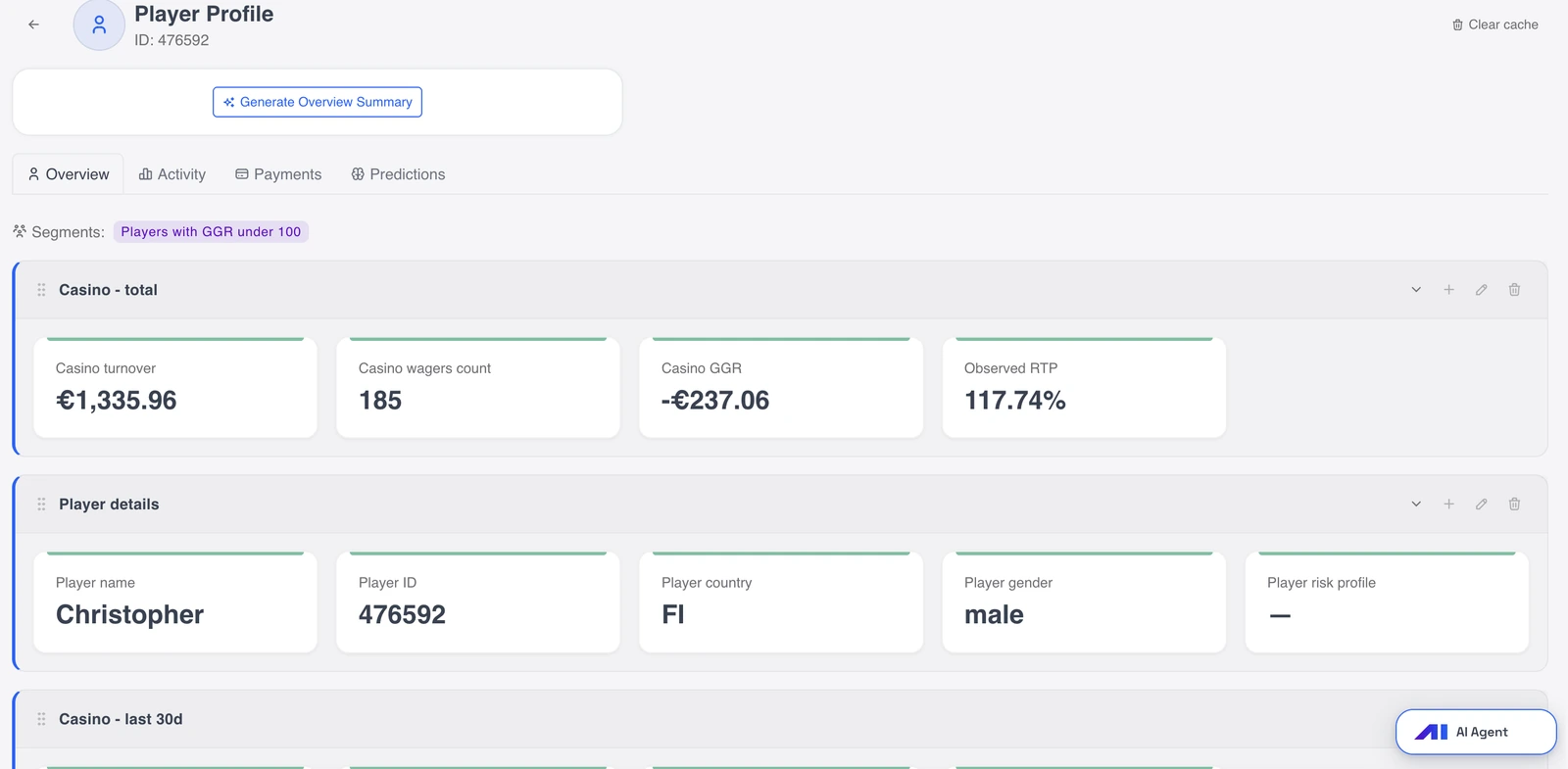
Four practical examples
From the first question
to a useful next step.
Explore the analysis, the comparisons and the context behind a decision. These are illustrative workflows, not customer results or preconfigured reports.
01 / Player-protection review
Put a behavioural change in context
What changed, over which period, and what else should the RG reviewer see?
An agreed RG process selects a player for review after a change in activity. The reviewer needs the history behind the selection, rather than an isolated flag or a commercial player-value ranking.
- Compare selected indicators with the player’s history, using consistent windows and available transaction states.
- Review permitted account context and connected RG history. Check missing periods and source changes that could explain the movement.
- Present the basis and supporting records to the specialist. Keep review and protective responses separate from retention or promotional decisions.
The RG team assesses the concern and determines follow-up under its process. Any predictive assessment is individually scoped and evaluated.
02 / Transaction assessment
Distinguish requested flows from completed movements
Does the apparent movement remain after transaction states are reconciled?
An AML reviewer investigates an account with deposits and withdrawal requests close together. A chart of requests can overstate completed outflows if pending, cancelled or rejected events are treated as settled payments.
- Match account and transaction identifiers. Put requests, state changes and completed movements in order using a consistent time zone.
- Separate currencies and transaction states. Review payment-method context only where those fields are supplied and the investigator is permitted to use them.
- Reconcile the analytical view against the original payment records. Identify unresolved differences before interpreting the pattern or preparing a case note.
The specialist decides whether further checks or operational escalation are required. Analytics does not establish criminal intent or file a report.
03 / Fraud review
Compare payment outcomes on a fair observation window
How do recorded chargeback rates differ across comparable payment cohorts?
Recorded chargebacks increased on one payment route. The team needs to separate larger volume, delayed reporting and a changed outcome rate before focusing its investigation.
- Define the eligible payment cohort, chargeback event and observation window. Exclude duplicate notifications and use consistent currencies.
- Compare mature cohorts by available method, market or acquisition context. Display transaction counts beside rates so small groups do not dominate the interpretation.
- Inspect representative records and the source's outcome classifications. A chargeback alone does not prove fraud, and a shared attribute does not prove accounts belong to the same person.
Choose records for specialist investigation and review the payment process. Restrictions and other actions stay within the operator's approved workflow.
04 / Evidence preparation
Check the coverage behind a case history
Which requested records are present, linked and still missing?
A specialist needs a defined period of player and transaction history. Start with a coverage check so a polished report does not conceal absent or unlinked records.
- Agree the requested entities, dates and record types. Identify which original systems hold authoritative records and which analytical copies are available.
- Check joins, event counts and status history against the source. Separate a genuinely absent event from a failed identity match or incomplete import.
- Prepare a Report or export with the analysis, scope and outstanding gaps. Have the responsible specialist validate the material before external use.
Resolve material gaps or explain the limits of the available evidence. Retain required case records through the operator's established process.
Agree the definitions
Measure the review process and its evidence
Define each measure around the team's purpose and connected records. Show review demand, completion and data coverage separately from the behaviour under assessment. A high alert count is not automatically a successful detection outcome.
Players selected for review
Distinct eligible players selected by an agreed rule or assessment during a stated period.
Understand workload and selection concentration. Keep the selection reason separate from the specialist's conclusion.
Review completion rate
Completed reviews divided by a defined review cohort, using connected case outcomes and a consistent cut-off.
Assess follow-up coverage without treating incomplete or unrecorded outcomes as completed decisions.
Age of pending reviews
Elapsed time since selection or case creation for reviews still pending at the snapshot time.
Examine delayed follow-up by review type and owner when that history is available.
Transaction reconciliation difference
The unmatched amount or event count between a defined source extract and the corresponding analytical records.
Find missing states, duplicates or cut-off differences before interpreting a payment pattern.
Matured chargeback rate
Eligible payments with a recorded chargeback divided by settled payments with the agreed observation window.
Compare payment cohorts on a consistent basis. Distinguish dispute outcomes from confirmed fraud classifications.
Evidence matching coverage
Successfully linked records divided by expected records for a specified source, entity and period.
Expose gaps in a case-history extract. Coverage does not certify the completeness of all evidence an investigation may require.
Make it part of the week
Build the analytical scope around the review
Start with the specialist's question and the evidence needed to answer it. Establish a usable review process before increasing the number of indicators or the volume of findings.
Define purpose and ownership
Agree whether the use case concerns player protection, fraud review, payment assessment or evidence preparation. Name the responsible specialists, eligible population, permitted data and operational destination for a finding.
Validate the history
Review transaction states, identity links and historical account changes. Compare samples with original systems and document what cannot be reconstructed. A current account status may not describe the status when earlier activity occurred.
Agree selection and review
Define the indicators, comparison periods and supporting context. If modelling is appropriate, scope its target and validation separately. Agree how reviewers record conclusions and how selected cases fit the team's capacity.
Evaluate and refine
Review unnecessary selections, missed concerns where evidence is available, incomplete follow-up and operational workload. Evaluate the quality of the assessment separately from the effect of any intervention; the two require different evidence.
Subscribe to Dashboards, download PDFs and deliver configured reports or notifications to email, Slack, Telegram, Google Chat or Microsoft Teams. Keep the review in the tools your team already uses.
Choose how the analysis starts
Ask. Keep checking.
Discover what deserves a closer look.
The same governed data supports different ways of working. Your team reviews the evidence and decides what happens next.
You ask
AI Agent
Explore a defined analytical question using the records and Metrics available to the role. Review the supporting numbers and narrow the scope. An AI explanation supports investigation; specialist judgement determines what it means for a case.
How did our recorded review workload change this month? Break it down by selection reason and pending age, and identify missing outcome records.Explore AI Agent
You define the check
Insight Radar
Schedule a recurring analytical review around agreed measures, periods and coverage. Keep the comparison scope and incomplete periods visible so specialists can prioritise follow-up.
Review matured chargeback rates by connected payment method each week. Compare eligible cohort sizes and flag incomplete observation windows alongside the results.Explore Insight Radar
It investigates
Autonomous Agent
Develop independently selected investigations in the available data. Relevant findings can prompt a specialist to examine an operational pattern. They do not establish wrongdoing, replace mandatory controls or trigger a protective action by themselves.
A finding highlights a shift in payment activity. The authorised team examines the source states and context before deciding whether it belongs in a specialist review.Explore Autonomous Agent
Connect the right context
Connect useful history, with clear boundaries
The analytical scope follows available records, lawful access and the team's purpose. Agree retention, access and handling with the operator; do not assume that an integration provides a complete case-management or regulatory record.
Sources to bring together
- Player and account identifiers, with relevant historical status changes where retained.
- Payment requests, completed movements, state changes, reversals and method context.
- Session, betting and gaming activity relevant to the agreed behavioural review.
- Existing RG indicators, protective actions and specialist review outcomes where connected and permitted.
- Fraud, dispute, verification or AML case records supplied by the operator's existing systems.
Checks that make the analysis useful
- Use verified identity links; shared devices, addresses or attributes alone do not establish a common account owner.
- Preserve transaction states, currencies, timestamps and source references needed for the analytical question.
- Distinguish a recorded negative outcome from an unknown or incomplete follow-up period.
- Apply purpose-appropriate access and keep RG or vulnerability signals separate from promotional targeting.
Before you begin
Practical questions.
Clear answers.
What fraud, rg, aml & compliance teams need to know about the data, the workflow and the available tools.
Does Gamblitude replace our fraud, AML or case-management systems?
It provides connected analytical data, player context and investigation tools. Existing systems continue to own their checks, case records, transaction decisions and required operational actions. The implementation should specify which records are imported and how specialists use the resulting analysis within their established process.
Is Responsible Gambling Risk Detection ready to switch on?
It is an individually scoped implementation. The RG and data teams agree the review question, selected indicators, method, output and evaluation. The approach may combine defined rules, predictive modelling and supporting history. Its purpose is professional player-protection review, independent of commercial player-value or retention targeting.
Does a risk score diagnose gambling harm?
No. A score's meaning depends on its agreed target, method and validation. A review-priority score is not automatically a probability of harm, and a behavioural assessment is not a clinical diagnosis. Reviewers need the supporting context and a defined process for deciding appropriate follow-up.
Can we identify linked accounts or suspicious transaction patterns?
Teams can analyse the identifiers, links and transaction histories supplied by connected sources. Use those connections to select records for review, then validate the relationship against the original systems. The validity of a link and the interpretation of a pattern require investigation.
Can the platform automatically restrict or contact a player?
An analytical finding or assessment does not execute an intervention. Contact, limits, restrictions and payment actions require a defined operational workflow, suitable integration and clear responsibilities. The scope should establish who reviews the evidence and which system performs an authorised action.
Does the analysis guarantee regulatory compliance?
It supports a defined part of the operator's analytical and review process. Applicable requirements, wider controls and the suitability of a particular submission remain matters for the responsible specialists. Shared definitions and source context help examination, but do not certify compliance or make an incomplete record complete.
How should we evaluate whether an assessment is useful?
Look at missed concerns, unnecessary selections, information available to reviewers and the workload created. Where a model predicts an outcome, evaluate it on separate periods from development. Then examine follow-up and subsequent outcomes separately; a detected pattern does not establish that an intervention caused an improvement.
What data and cadence are needed?
Start with the specific review and the decision timeline. Assess behavioural and transaction history, relevant account context, available outcomes and gaps. Freshness depends on source access and processing. Agree delivery cadence and coverage explicitly rather than assuming every source updates continuously or every historical state is retained.
See it with your team
Start with the review.
Define the evidence.
Bring the specialist question, current indicators and available history. We will work with your team to define a practical analytical scope and how its usefulness should be evaluated.