What iGaming operators should really take from McKinsey’s 2025 AI Survey
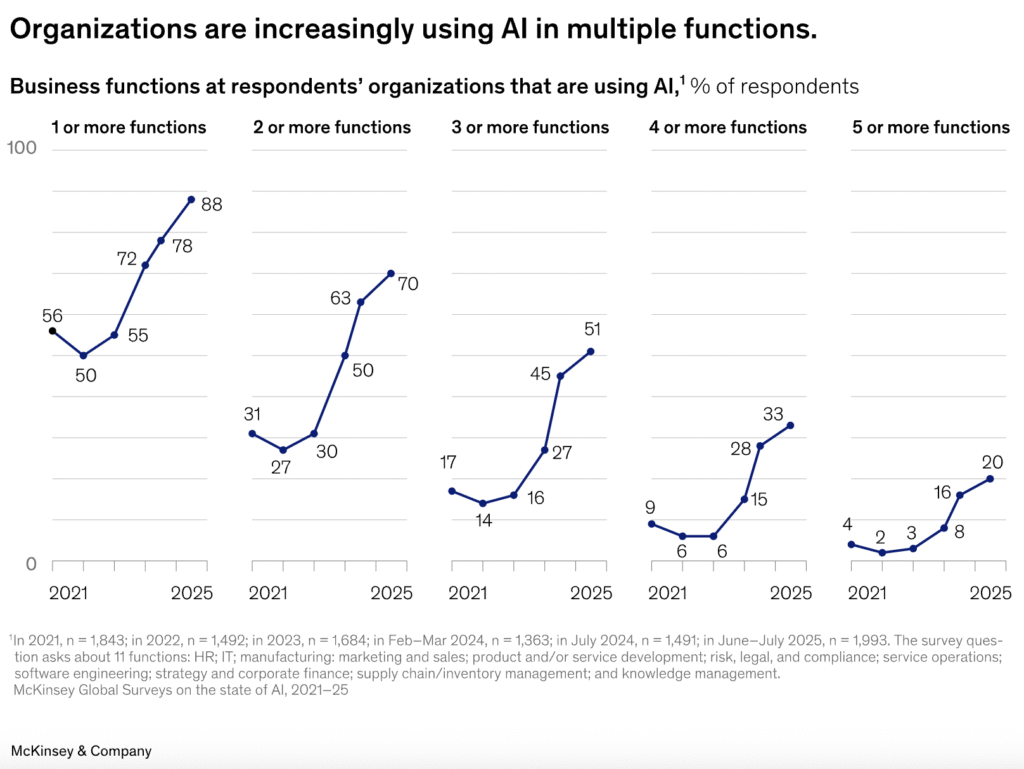
McKinsey’s latest “The state of AI in 2025: Agents, innovation, and transformation” report paints a picture that’s both exciting and sobering. Nearly nine out of ten global enterprises already use AI in some part of their business. Yet only a third have scaled it in a way that creates real, measurable impact at the enterprise level.
The report, based on responses from almost 2,000 executives worldwide, shows a market full of experiments, prototypes and pilots, but still short of consistent value. This finding feels very familiar to anyone in the iGaming industry.
Operators, casinos, sportsbooks, affiliates – everybody talks about AI. Some are running machine learning models for churn prediction or early VIP detection. Others are experimenting with large language models (LLMs) and AI agents to automate reporting or support. But the truth is that most of it still lives in silos, disconnected from real workflows, KPIs or decision-making.
At Gamblitude, we looked at McKinsey’s findings through the lens of iGaming and asked a simple question: what can our industry actually learn from this?
1. Everyone is experimenting. Very few are scaling.
McKinsey’s data:
Two-thirds of companies are still in the experimentation or piloting stage. Only about one-third are scaling AI across the enterprise.
In iGaming, the pattern is identical. A fraud detection model here, a CRM churn predictor there, maybe a chatbot for support. Each works in isolation.
The problem isn’t the math – it’s the infrastructure. You can’t scale AI or ML when your sportsbook data lives in one system, casino data in another and affiliate data in yet another. Without a single version of the truth – one governed data layer – there’s nothing for AI to build on.
That’s why AI maturity in iGaming will come not from more experiments, but from connecting them. Anomaly detection, player segmentation, predictive churn models – all of them need the same clean metrics, same definitions, same source of truth.
2. AI vs ML: two sides of the same story
McKinsey talks about the rise of AI agents – systems that can plan, act and execute multiple steps in a workflow. About 62% of respondents say their companies are experimenting with them.
In iGaming, this translates to a clear division:
- Machine Learning (ML) handles specific predictive tasks – for example, predicting player churn, early flagging high-value players, detecting risk anomalies.
- Artificial Intelligence (AI / LLMs) turns those insights into action – summarising, narrating, recommending, explaining.
The synergy is where the value lies. ML tells you what might happen. AI tells you why it matters and what to do next.
High performers in the McKinsey survey are already combining both layers. They run predictive models under the hood and surface them via AI agents that can brief entire teams. That’s exactly the direction iGaming analytics should be moving toward.
3. High performers don’t just automate – they innovate
According to McKinsey:
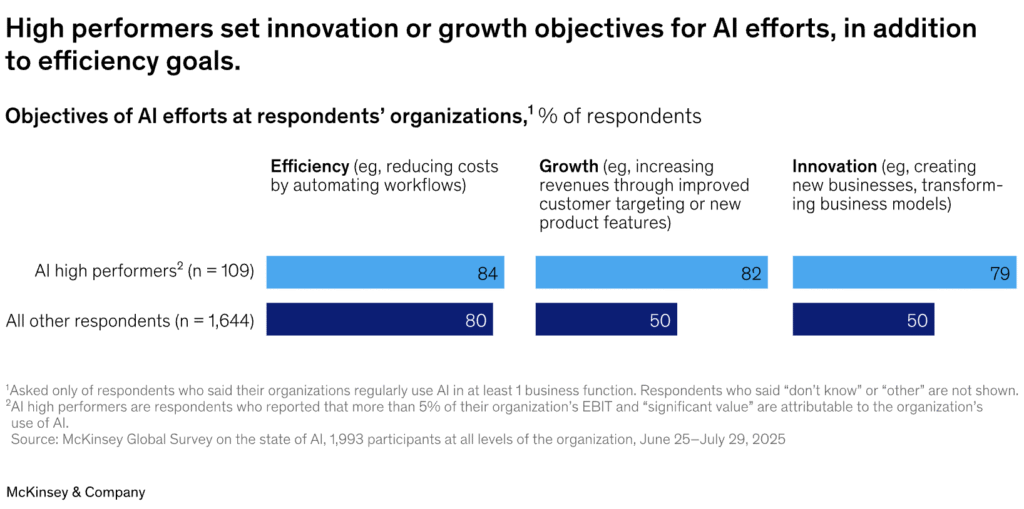
80% of companies set efficiency as their main AI goal. The real value creators also set growth and innovation goals.
In other words, the best companies don’t just use AI to save time. They use it to make better products, faster decisions and new revenue streams.
In iGaming, the same logic applies.
Reducing manual reporting is good, but it doesn’t move the bottom line.
Using AI to automatically detect mispriced bonuses, track VIP behaviour changes or predict sportsbook liability in real time – that’s where impact compounds.
Operators that frame AI around growth rather than cost will define the next phase of competition.
4. Workflow redesign is where real transformation happens
McKinsey points out that companies seeing measurable AI impact are almost three times more likely to redesign their workflows rather than just layering new tools on top of existing processes.
In practice, this means AI and ML should not operate as isolated assistants. They need to be embedded directly into how work gets done – from monitoring KPIs to decision-making routines.
In iGaming, the difference is clear.
If a model only alerts an analyst that RTP has drifted, the process still depends on manual verification and follow-up.
If the same insight is automatically validated against governed metrics, summarized and distributed to the relevant team, that becomes a redesigned workflow, becomes faster, traceable and consistent across departments.
This shift is less about new software and more about clarity of process: defining where human judgment is required, where automation is safe and how results are verified. In regulated sectors like gaming, that alignment between data, automation and accountability is what separates pilots from operational AI.
5. Scale is not about size, it’s about structure
McKinsey notes that larger enterprises are further along in scaling AI, mainly because they already have structured data, clear ownership and repeatable processes. In iGaming, the challenge is different. Operators may not have hundreds of data engineers, but they do have something equally valuable: a constant stream of granular data across bets, sessions, payments and player activity.
The real bottleneck isn’t headcount. It’s fragmentation.
Data spread across multiple systems, inconsistent KPIs, disconnected teams – that’s what keeps AI stuck at the pilot stage.
Scaling AI in iGaming doesn’t mean building huge internal AI labs. It means creating one governed layer where both ML and AI can operate safely and consistently. Once data is unified and metrics are standardized, models can be retrained automatically and AI agents can act on results across teams.
That’s when AI stops being a project and starts being part of daily operations.
6. Risk, compliance and explainability are not optional in iGaming
McKinsey highlights that over half of surveyed organizations using AI have already experienced at least one negative consequence – most often related to inaccuracy or lack of explainability. In industries like iGaming, where every data point can have regulatory or financial implications, those risks multiply.
A misinterpreted retention signal or a false positive on responsible gaming is not just a technical error – it’s a compliance incident. That’s why treating AI as a generic automation layer simply doesn’t work here.
For iGaming operators, data governance must come first. AI outputs are only as reliable as the metrics that define them. When every KPI is calculated through a governed metrics engine – with versioning, validation and clear ownership – you can trace every AI-generated statement back to a verified data source.
On top of that, AI in this domain needs to be trained and prompted within the context of gaming logic: bet structures, RTP, NGR formulas, segmentation models, regulatory thresholds. Without this domain grounding, even the most advanced model will produce insights that look convincing but aren’t operationally safe.
In short: explainability in gaming isn’t just about showing “how AI reached a conclusion”. It’s about ensuring that the conclusion itself aligns with how the business and regulators define truth.
7. What the survey really tells iGaming
If we sum it up, McKinsey’s 2025 findings highlight a clear path that operators can adapt directly:
- Start with data foundations. Define and unify metrics across verticals – sportsbook, casino, payments, risk.
- Layer in ML where prediction adds real value. Churn, fraud, VIP detection, RTP drift.
- Use AI (LLMs and agents) for interpretation and action. Insights, reporting, alerting, communication.
- Redesign workflows around data and AI. Don’t just observe anomalies – act on them automatically.
- Govern everything. Traceability, permissions and explainability are non-negotiable.
The operators who follow this path will mirror the “high performers” from the McKinsey report – achieving measurable impact across revenue, efficiency and innovation.
Final thought
McKinsey’s survey shows that the world has moved past the question of “Should we use AI?” The question now is “How do we make it work across the enterprise?”
For iGaming, the answer lies not in isolated experiments, but in connected intelligence.
That means data you can scale, metrics you can trust and AI that knows your business better than any external API service ever could.
Source: Based on The State of AI 2025 – McKinsey Global Survey, interpreted for the iGaming industry by Gamblitude.